
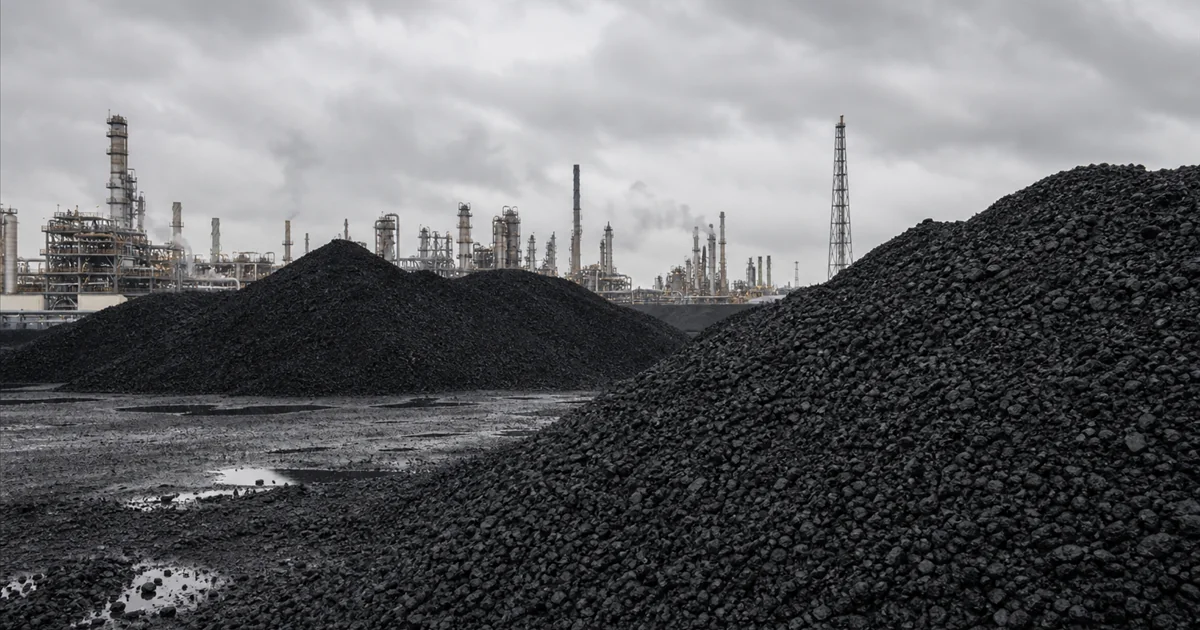
What is petroleum coke
Petroleum coke (commonly called petcoke) is a solid, black or dark grey carbonaceous material produced as a by-product of the delayed coking process in oil refineries. When heavy residual oil fractions (vacuum residue, atmospheric bottoms) are thermally cracked at temperatures of approximately 480–510 °C, the volatile components are driven off and the remaining material solidifies into coke.
Petcoke consists primarily of fixed carbon (85–92%), with smaller amounts of sulfur, volatile matter, ash and moisture. Its calorific value (7,800–8,600 kcal/kg) is significantly higher than most thermal coals, making it a cost-effective energy source for industrial applications.
Global petroleum coke production exceeds 160 million tons per year, with major producing regions including the United States, China, India and Russia. Russian refineries have substantially increased coking capacity in recent years through modernisation programmes, producing significant volumes of both fuel grade and anode grade petcoke for export.
Production — delayed coking process
Petroleum coke is produced through the delayed coking process — one of the most widely used refinery conversion units for processing heavy residues:
- Feed preparation — Vacuum residue (the heaviest fraction from the vacuum distillation unit) is preheated in a furnace to approximately 480–510 °C. The feed may be blended with recycled heavy coker gas oil to control coke quality.
- Coking (thermal cracking) — The heated feed enters large cylindrical vessels called coke drums (typically in pairs for continuous operation). Inside the drum, the heavy hydrocarbons undergo thermal cracking — lighter products (gases, naphtha, gas oils) vaporise and exit through the top, while the heavier molecules polymerise and condense into solid coke on the drum walls.
- Coke cutting and dewatering — Once the drum is full of coke (cycle time ~16–24 hours), it is switched offline. High-pressure water jets (~250–350 bar) are used to cut and remove the coke from the drum. The wet coke is conveyed to a dewatering pad and subsequently to storage.
- Quality control and loading — Coke is sampled and analysed for sulfur, volatile matter, fixed carbon, ash, moisture, hardgrove grindability index (HGI) and metals (vanadium, nickel). After classification by grade, petcoke is loaded into railcars, trucks or directly onto vessels for export.
Russian refineries operating delayed cokers include major complexes in Omsk, Volgograd, Perm, Salavat, Ufa and others. Export logistics typically route through Black Sea ports (Novorossiysk, Taman) and Baltic ports (Ust-Luga, St. Petersburg).
Fuel grade vs anode grade petcoke
Petroleum coke is broadly classified into two commercial grades based on quality and end-use:
Fuel grade petcoke (FGPC)
The majority (~75–80%) of global petcoke production is fuel grade. Fuel grade petcoke has higher sulfur (typically 4–7%), higher metals content and is used primarily as a solid fuel — a direct substitute or supplement for coal in cement kilns, industrial boilers and power plants. Its high calorific value and low ash content (compared to coal) make it economically attractive despite higher sulfur.
Anode grade petcoke (AGPC)
Anode grade petcoke has lower sulfur (typically <3%, premium grades <1.5%), lower metals (vanadium <250 ppm, nickel <200 ppm) and a characteristic sponge-like structure. It is used as the primary raw material for producing calcined petroleum coke (CPC), which is then manufactured into carbon anodes for the aluminium smelting industry (Hall-Héroult process). Anode grade commands a significant price premium over fuel grade.
| Parameter | Fuel Grade | Anode Grade |
|---|---|---|
| Sulfur | 4.0–7.0% | 0.5–3.0% |
| Vanadium | 200–1,500 ppm | <250 ppm |
| Nickel | 100–500 ppm | <200 ppm |
| Volatile matter | 8–14% | 8–12% |
| HGI | 35–75 | 40–70 |
| Primary use | Fuel (cement, power) | Calcination → aluminium anodes |
Typical specifications — fuel grade petcoke (Russian origin)
Specifications vary by refinery and crude oil slate. Russian petcoke from Urals-based refineries processing domestic crude typically falls in the medium-sulfur range (2.5–5.5%), which is well-suited for cement production and blending with coal. Exact specifications are provided per shipment with Certificate of Analysis.
Applications — cement, aluminium, steel, power
- Cement industry: The largest consumer of fuel grade petcoke globally. Petcoke is used as kiln fuel, either alone or blended with coal (typically 70–100% petcoke substitution rates). Its high CV and low ash reduce fuel costs per ton of clinker. Most modern cement plants are equipped to handle petcoke's sulfur content, as sulfur is absorbed into the clinker.
- Aluminium smelting: Anode grade petcoke is calcined at ~1,300 °C to produce CPC (calcined petroleum coke), which is mixed with coal tar pitch to form carbon anodes for the Hall-Héroult electrolytic process. Approximately 0.4 tons of CPC are consumed per ton of aluminium produced.
- Steel industry: Petcoke is used as a carbon additive (carburiser) in electric arc furnaces and as a fuel in blast furnace injection. Calcined petcoke provides a high-purity carbon source for steelmaking.
- Power generation: Petcoke is burned in circulating fluidised bed (CFB) boilers or co-fired with coal in pulverised coal power plants. CFB technology is particularly suited to high-sulfur petcoke due to in-bed limestone desulfurisation.
- TiO2 production: Calcined petcoke is used as a reductant in the chloride process for manufacturing titanium dioxide pigment.
- Other industrial uses: Gasification to produce syngas, carbon black feedstock, silicon carbide (SiC) and calcium carbide production.
Market overview and buyer profile
The global petroleum coke market is driven by the cement and aluminium industries, which together account for over 70% of demand:
Cement sector demand: Rapidly growing cement industries in India, Southeast Asia, Africa and the Middle East are major importers of fuel grade petcoke. India alone imports 10–15 million tons annually, making it the world's largest petcoke importer. Petcoke offers a 20–40% cost saving versus thermal coal on a per-calorie basis.
Aluminium sector: Global aluminium production (~70 million tons/year) requires approximately 28 million tons of anode grade petcoke. Key aluminium-producing regions — China, Middle East (UAE, Bahrain, Saudi Arabia), Russia, Canada, Norway — are the primary consumers of anode grade material.
Russian petcoke exports: Russia's refinery modernisation programme has significantly increased delayed coking capacity. Russian petcoke is exported primarily via Black Sea and Baltic ports, with major buyers in Turkey, India, China, Middle East and North Africa.
Pricing for fuel grade petcoke is typically benchmarked against US Gulf Coast FOB assessments, adjusted for quality (sulfur, CV) and freight. Anode grade carries a substantial premium depending on sulfur and metals content.
Documentation and certificates
Each petroleum coke shipment is accompanied by:
- Commercial Invoice
- Bill of Lading (B/L)
- Certificate of Analysis (CoA) — sulfur, fixed carbon, volatile matter, ash, moisture, CV, HGI, metals
- Certificate of Weight (draft survey or shore scale)
- Certificate of Origin
- Customs Export Declaration
- Insurance Certificate (CIF shipments)
- Phytosanitary certificate (if required by destination)
Independent inspection (SGS, Bureau Veritas, Intertek or other) at loading port can be arranged to verify quality and quantity. Sampling and analysis are performed in accordance with ASTM D4057 / ISO 10370 standards.
Request petroleum coke availability and pricing
To receive a quotation for petroleum coke supply, please provide:
- Grade — fuel grade or anode grade
- Volume (metric tons) — annual contract or spot cargo
- Sulfur specification (max %)
- Size requirements (if any)
- Delivery: FOB (loading port) or CIF (destination port)
- Required delivery period / schedule
Start qualification — submit grade, volume, delivery basis and timeframe via our structured inquiry path, or reach us on Telegram / E-mail.
Petroleum coke frequently asked questions
What is petroleum coke (petcoke)?
Petroleum coke (petcoke) is a solid, carbon-rich material produced as a by-product of the delayed coking process in oil refineries. It is formed when heavy residual oil fractions (vacuum residue) are thermally cracked at high temperatures (~500 °C) to maximise lighter product yields. Petcoke has a very high calorific value (7,800–8,600 kcal/kg) and fixed carbon content (85–92%), making it a cost-effective fuel and carbon source for industrial applications.
What is the difference between fuel grade and anode grade petcoke?
Fuel grade petcoke typically has 4–7% sulfur and higher metals content. It is used as a solid fuel in cement kilns, power plants and industrial boilers. Anode grade petcoke has lower sulfur (<3%), lower metals (vanadium, nickel) and a sponge-like structure suitable for calcination. Calcined petcoke (CPC) is then used to manufacture carbon anodes for aluminium smelting. Anode grade commands a significant price premium over fuel grade.
What industries use petroleum coke?
The main consumers are: the cement industry (kiln fuel replacing coal — the largest consumer globally), aluminium smelters (calcined petcoke for carbon anodes), the steel industry (as a carbon additive and fuel), power generation (in circulating fluidised bed boilers), and TiO2 production. India, Southeast Asia, the Middle East and Africa are among the largest petcoke importing regions.
What is the calorific value of petcoke?
Fuel grade petroleum coke typically has a gross calorific value (GCV) of 7,800–8,600 kcal/kg (32.6–36.0 MJ/kg), which is significantly higher than most thermal coals (5,000–6,500 kcal/kg). This high energy density makes petcoke an economically attractive fuel, offering 20–40% cost savings compared to coal on a per-calorie basis.
How do I purchase petroleum coke?
Send your requirements — grade (fuel or anode), volume (MT), sulfur specification, delivery basis (FOB or CIF and destination port), and timing — to Telegram @AlghafMarine_bot or e-mail. We will respond with availability, pricing, specifications from specific refineries, and documentation details.
Related petroleum coke products
Petroleum Naphtha · Fuel Oil RMG 380 · Bitumen · Gasoil · Logistics & FOB/CIF
Alghaf Marine DMCC — petroleum products trading. Availability, pricing and specifications upon request.